

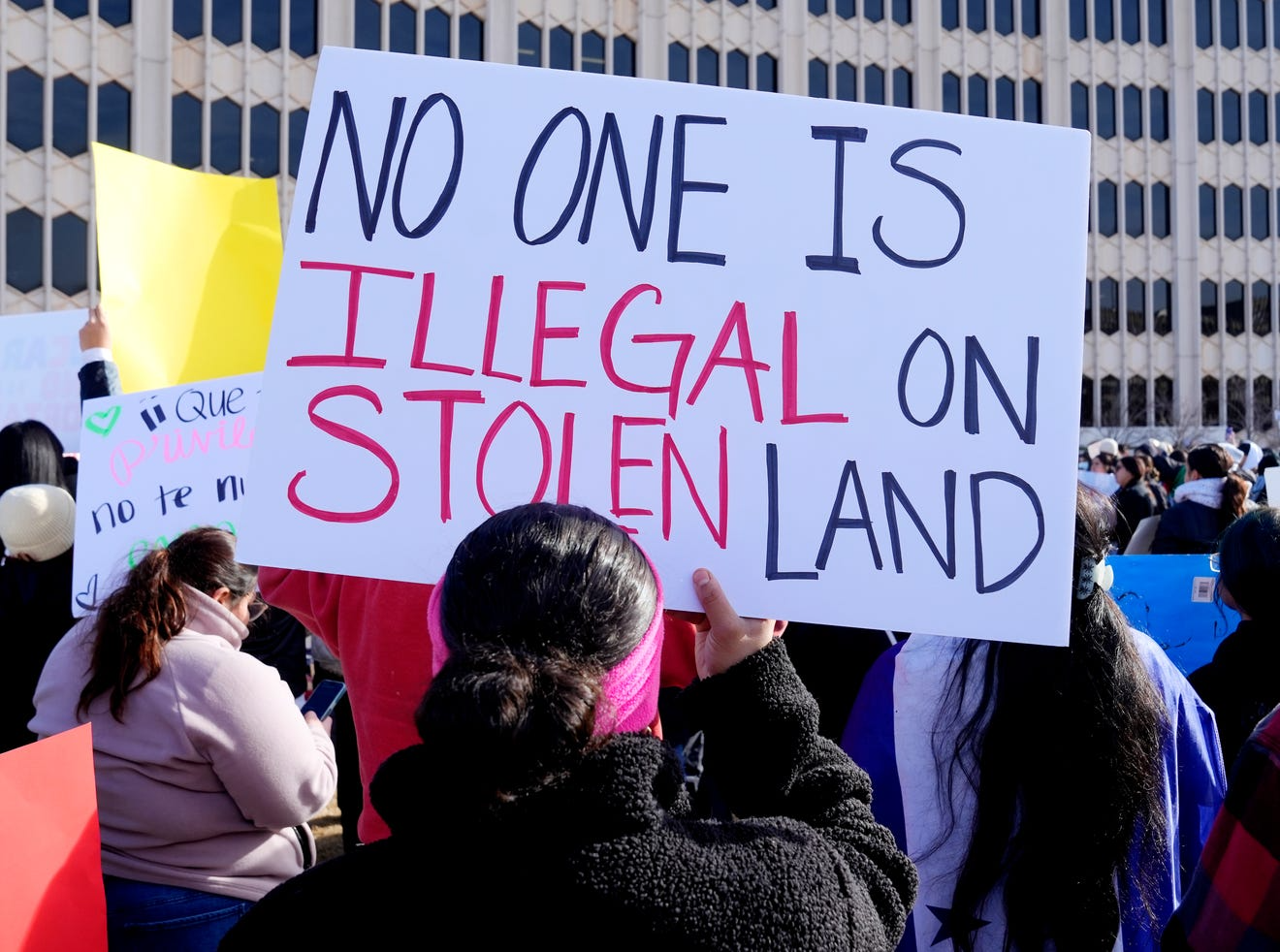
The claim that the United States is “stolen land” has become a moral shorthand in contemporary political discourse. It appears in land acknowledgments, protest rhetoric, academic writing, and social media posts, often offered as a settled truth rather than an argument. Its emotional force is undeniable. Its analytical rigor is not.
This essay does not deny the violence, displacement, or injustice experienced by Indigenous peoples in North America. Those facts are documented, tragic, and deserving of serious attention. What it challenges is the framing of the entire American project as an act of theft, a claim that collapses history, law, and morality into a single slogan and, in doing so, obscures more than it clarifies.
If we are going to confront history honestly, we need precision, not incantation.
What the Claim Asserts
At its strongest, the “stolen land” argument holds that the United States rests on the dispossession of Indigenous nations through conquest, coercion, and broken treaties. Because this dispossession was unjust, the argument continues, modern American sovereignty is morally compromised and demands ongoing acknowledgment, restitution, or structural redress.
This is a moral argument, not merely a historical one. It is meant to shape how people understand legitimacy, belonging, and responsibility in the present. That is precisely why it deserves careful scrutiny.
“Stolen” Is Doing Moral Work, Not Historical Work
The word “stolen” has a specific meaning. It presumes a recognized system of property, a shared legal framework, and mutually acknowledged rules of ownership. Theft is not simply taking something by force. It is taking something that is defined as owned under an agreed-upon system of law.
Much of pre-colonial North America did not reflect European-style concepts of private land ownership or fixed national borders. Indigenous societies governed territory in diverse ways, often based on use, kinship, migration, seasonal movement, or overlapping claims. This does not mean those societies lacked order, culture, or sovereignty. It does mean that applying a modern, Western property concept retroactively risks distorting the historical reality.
When people say the land was “stolen,” they are not making a legal claim. They are making a moral one. That distinction matters. Moral condemnation does not require imprecise language, and imprecision weakens the case it seeks to advance.
Conquest Was the Rule, Not the Exception
If territorial conquest delegitimizes sovereignty, then most nations on earth fail the test.
Empires rose and fell through force long before Europeans arrived in the Americas. Indigenous nations displaced rival tribes. The Aztec Empire expanded through warfare and tribute. The Iroquois Confederacy absorbed and displaced neighboring peoples. Across the globe, borders shifted through conflict, not consent.
None of this excuses American expansion or its brutality. It does, however, raise a serious problem for the “stolen land” framework. The argument is rarely applied universally. It is applied selectively, almost exclusively to Western settler states, as though conquest became illegitimate only when Europeans practiced it.
A moral principle that applies only to one civilization is not a principle. It is a political judgment, and it should be acknowledged as such.
Treaties and Agency Complicate the Story
The popular version of the narrative suggests a simple sequence: Europeans arrived, stole land, and pushed Indigenous peoples aside. The historical record is far more complex.
Some land was seized violently. Some was taken after treaties were broken. Other land was purchased, traded, or ceded under pressure. Indigenous nations entered alliances, made strategic decisions, fought wars against other tribes, and negotiated with colonial powers in pursuit of survival and advantage.
To reduce this history to a single moral verdict strips Indigenous peoples of agency and turns them into passive symbols rather than historical actors. Complexity is not denial. It is accuracy.
Retroactive Moral Absolutism Has No End Point
Even if one accepts the full moral indictment implied by “stolen land,” the practical implications remain unresolved.
Which land is stolen, exactly. Returned to whom. Under what authority. With what consequences for the millions of people who now live there, many of whom arrived generations after the original acts of dispossession.
The slogan offers no coherent answers. It functions as a declaration, not a program. That does not make it meaningless, but it does make it incomplete.
A moral framework that cannot articulate a realistic path forward risks becoming symbolic rather than substantive, more about signaling awareness than addressing injustice.
Acknowledgment Does Not Require Delegitimization
The United States can acknowledge historical wrongs without declaring itself illegitimate. It can teach the history of displacement honestly. It can honor treaty obligations where they remain enforceable. It can support Indigenous self-determination, cultural preservation, and economic opportunity today.
None of that requires describing the country itself as a crime scene or its citizens as permanent beneficiaries of theft.
Responsibility is not the same thing as self-annulment. Mature societies confront their past without erasing the present.
Precision Is Not Denial
Calling America “stolen land” may feel morally satisfying, but it is analytically blunt. It replaces history with shorthand, law with metaphor, and complexity with absolutes. In doing so, it weakens the very reckoning it claims to demand.
History deserves better than slogans. It deserves language that clarifies rather than obscures, that assigns responsibility without collapsing into mythology, and that recognizes injustice without abandoning reason.
Precision is not a refusal to confront the past. It is the only way to do so honestly.

Leave a Reply