
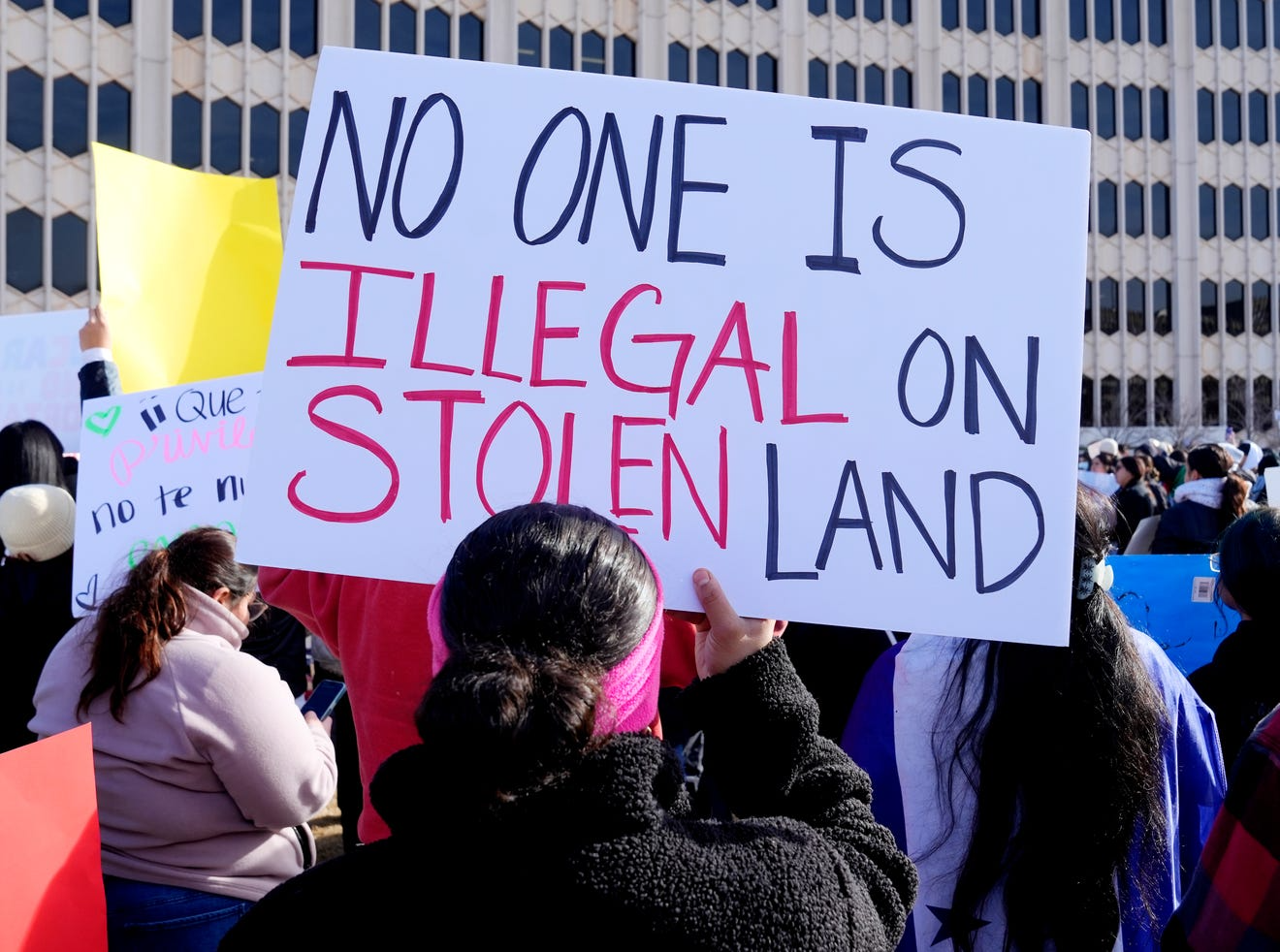
The slogan “Nobody is illegal on stolen land” appears frequently at anti-ICE protests and in immigration activism. It is designed to sound self-evident, even humane. Who, after all, wants to argue that a person is “illegal”? But slogans are not arguments, and this one collapses moral grievance, historical dispute, and legal reality into a single chant that obscures more than it explains.
This essay is not a defense of every immigration policy, nor an endorsement of every enforcement decision. It is an examination of what the slogan asserts, what it denies, and why its framing is factually and legally wrong—regardless of one’s views on borders, enforcement, or reform.
What the Slogan Claims to Do
At a glance, “Nobody is illegal on stolen land” attempts three moves at once.
First, it reframes immigration law as morally void by invoking historical injustice. Second, it treats current borders as illegitimate by definition. Third, it delegitimizes immigration enforcement by implying that those who carry it out have no lawful authority.
Each move depends on rhetorical compression. Each fails under scrutiny.
“Illegal” Describes Status and Conduct, Not Human Worth
No person is illegal in the sense of being subhuman or undeserving of dignity. Immigration law does not claim otherwise. What it regulates is status and conduct: entry without authorization, overstaying a visa, or violating the terms of admission.
This distinction is not semantic. It is foundational. Laws routinely describe conduct as unlawful without assigning moral worth to the individual. Driving without a license is illegal. Building without a permit is illegal. These labels do not erase personhood.
The slogan deliberately blurs this line. By collapsing legal status into identity, it turns disagreement with immigration law into a claim about human value. That may be rhetorically effective, but it is intellectually dishonest. One can oppose current immigration laws without misrepresenting what the law actually says.
Historical Grievance Does Not Nullify Present Sovereignty
The second move in the slogan relies on the claim that the land itself is “stolen,” and that this theft voids the legitimacy of all subsequent law. This argument has already been addressed in the companion essay on the limits of the “stolen land” framing. Here, its implications matter more than its rhetoric.
Even if one accepts the strongest version of the historical indictment, it does not follow that present-day sovereignty disappears. Law does not function on retroactive moral annulment. If it did, no modern state would remain legitimate, and no law anywhere would be enforceable.
Borders exist not because history was pure, but because authority exists now. Courts operate. Statutes apply. Governments exercise jurisdiction. These facts are not erased by slogans.
To argue otherwise is to replace law with assertion. That is not how societies govern themselves.
Immigration Law Exists Whether One Approves of It or Not
Opposition to immigration law is not the same as the nonexistence of immigration law. This distinction is frequently ignored in protest rhetoric.
A person may believe the law is unjust, overly restrictive, or in need of reform. Those positions are arguable. What is not arguable is that immigration law is currently in force and enforceable. It is passed by Congress, upheld by courts, and applied daily by federal agencies.
The slogan does not argue for changing the law. It declares the law illegitimate by moral fiat. That may feel satisfying, but it offers no pathway forward. It does not persuade lawmakers, guide courts, or clarify policy. It simply denies reality.
ICE Is Federal Law Enforcement
Another common claim accompanying the slogan is that ICE agents are “not real law enforcement.” This is false.
ICE officers are sworn federal agents. They operate under statutory authority. They enforce immigration law, but their authority is not limited to it. Like other federal law enforcement officers, they can investigate and enforce violations of federal criminal law when circumstances require.
This is not a political opinion. It is a matter of law.
Disliking an agency does not strip it of its legal status. Declaring officers illegitimate does not make them so. When protesters insist otherwise, they are not making a moral argument. They are denying a factual one.
Delegitimization as a Political Strategy
The deeper problem with the slogan is not simply that it is inaccurate. It is that it trains people to treat law itself as optional.
If borders are inherently illegitimate, then enforcement is inherently immoral. If enforcement is inherently immoral, then law enforcement officers become villains by definition. This logic leaves no room for democratic disagreement, institutional reform, or lawful change. It replaces all of that with moral absolutism.
History offers ample warning about what happens when political movements abandon legal reasoning in favor of declarative righteousness. The result is not justice. It is instability.
Moral Protest Is Not a Substitute for Legal Argument
Protest has a legitimate role in democratic societies. It draws attention. It expresses dissent. It pressures institutions. But protest does not rewrite law by repetition.
If the goal is to change immigration policy, the work involves legislation, litigation, and persuasion. It involves acknowledging the law as it exists and arguing for how it should be different. Chanting that the law is void because history was unjust does none of that.
Worse, it erodes public understanding. It teaches people that disagreement with a law means the law is fake, that enforcement equals violence by definition, and that authority is only legitimate when it aligns with one’s moral intuition.
That is not reform. It is refusal.
A Clearer Way Forward
None of this requires indifference to human suffering. It does not require silence about historical injustice. It does not require uncritical support for current enforcement practices.
It requires clarity.
One can say immigration law is flawed without pretending it does not exist. One can argue ICE should be reformed without denying that its agents are law enforcement. One can acknowledge historical wrongs without declaring modern governance illegitimate.
Slogans feel powerful because they simplify. But simplification has costs. When language replaces reality, movements lose credibility, institutions lose trust, and debate becomes impossible.
If immigration policy is to change, it will change through argument, not incantation. Through law, not denial. And through clarity, not slogans that promise moral certainty while delivering conceptual confusion.
This essay is not a demand for agreement. It is a demand for precision.


Leave a Reply